


Minimally Invasive Treatment Offered in a Private Clinic Setting
Carpal Tunnel Release
Dr Charles Guertin offers Carpal Tunnel Release at his clinic for patients seeking timely access to treatment for Carpal Tunnel Syndrome.
This procedure is performed using a minimally invasive technique, in a non-hospital setting, for eligible patients following a medical evaluation.
Understanding Carpal Tunnel Syndrome

Tingling and numbness may occur in the fingers or hand. Usually the thumb, index, middle and ring fingers are affected, but not the little finger. You might have a feeling like an electric shock in these fingers. These symptoms often occur while holding a steering wheel, phone or newspaper, or they may wake you from sleep.

People with carpal tunnel syndrome may experience weakness in the hand and drop objects. This may be due to numbness or to weakness of the thumb's pinching muscles, which also are controlled by the median nerve.

Carpal tunnel pain is often worse at night due to fluid accumulation, decreased circulation, and, most commonly, sleeping with wrists bent, which increases pressure on the median nerve.

Difficulty with Fine Motor Tasks: Individuals may experience trouble with tasks requiring dexterity, such as buttoning shirts, writing, typing, or handling small objects. Weakness and Clumsiness: A loss of grip strength, leading to dropping objects, is common, particularly as the condition progresses.
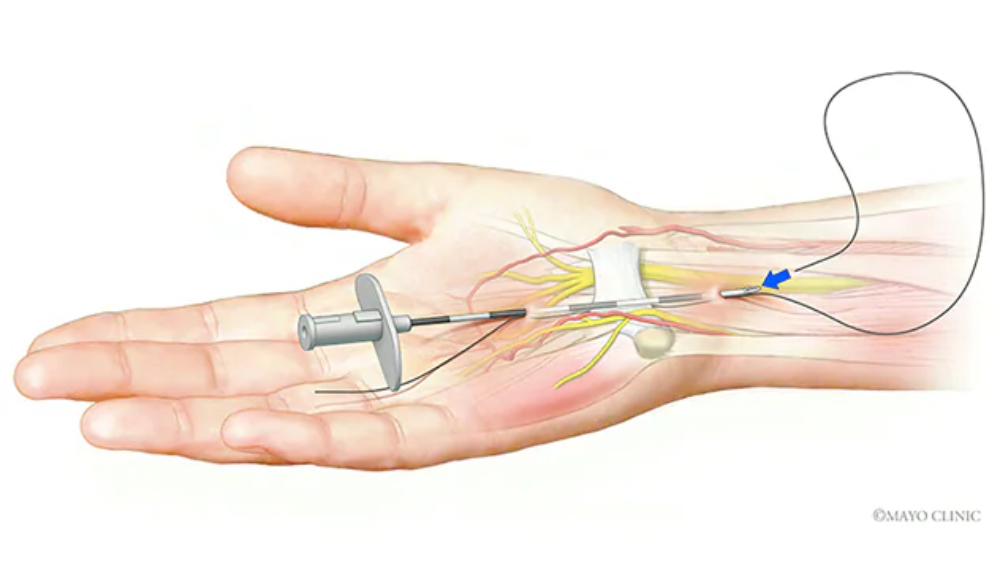
What Is Carpal Tunnel Release?
At the clinic, the procedure is:
- Performed under local anesthesia
- Minimally invasive
- Conducted in a controlled clinical environment
- Typically completed during a short visit
Public vs Private Care in Quebec — Understanding the Difference
In Quebec, Carpal Tunnel Release is also available through the public health system and is covered by RAMQ when performed in a hospital setting.
However, due to system capacity and prioritization, waiting times in the public system can be lengthy, depending on region and clinical urgency.
Some patients choose a private clinic option primarily to address access and timing, not because the procedure itself differs medically.
Consultation and Evaluation
Not all patients are candidates for this procedure.
A consultation includes:
Medical evaluation
Review of diagnostic findings
Discussion of treatment options
Explanation of benefits, risks, recovery, and fees
No treatment is performed without proper assessment and informed consent.
Public System (Hospital)
• Covered by RAMQ
• Hospital-based care
• Variable wait times
Private Clinic
• Procedure not covered by RAMQ
• Faster access for eligible patients
• Clinic-based setting
• Fees discussed transparently in advance
Choosing private care does not affect eligibility for public care.
Why Some Patients Consider a Private Option
Patients may consider a private clinic when:
• Symptoms significantly affect daily activities or work
• Conservative treatments have not provided relief
• They prefer not to wait extended periods for treatment
• Scheduling flexibility is important
The decision is personal and based on individual circumstances.
Consultation and Evaluation
Not all patients are candidates for this procedure.
A consultation includes:
Medical evaluation
Review of diagnostic findings
Discussion of treatment options
Explanation of benefits, risks, recovery, and fees
No treatment is performed without proper assessment and informed consent.
Make an appointment today
(514) 257-1860
[email protected]
2601, rue William-Tremblay, bureau 320